Why solar-plus-storage is the fastest-growing energy segment globally
Solar photovoltaic capacity has grown faster than any analyst predicted a decade ago — but its Achilles heel is intermittency. A rooftop PV system generates electricity only when the sun shines; any excess is exported (often at low feed-in tariffs) or wasted. Storage solves this by capturing excess generation for use when the sun doesn't shine.
The combination of falling battery costs (LiFePO4 system costs have declined 60% since 2020), rising grid electricity prices, and generous net metering or feed-in tariffs in many markets has made solar-plus-storage economically compelling across residential, commercial, and industrial segments.
Component overview: what's in a solar-plus-storage system
A complete system consists of:
- Solar panels — PV modules ranging from 400W residential panels to 550W+ commercial panels; typically mounted on rooftops or ground arrays
- Hybrid inverter — The brain of the system; manages solar input, battery charging/discharging, grid export/import, and loads. Key specs: max PV input voltage, AC output power, battery voltage range, and grid code certifications
- Battery bank — LiFePO4 is the dominant chemistry for new installations (superior cycle life, thermal safety vs NMC); sized in kWh of usable capacity
- Mounting hardware — Roof mounting kits, ground racking, anti-theft fixtures for outdoor installations
- Monitoring & control — WiFi/cloud-connected monitoring apps, export power limiters, EMS integration
Sizing guide: residential (5-15kWh)
For residential systems, the key question is: what do you want to achieve?
- Backup only — Size battery to cover critical loads during outages. A typical 5kWh battery covers 8-12 hours of lights, refrigerator, and WiFi for an average home
- Self-consumption optimization — Size battery to store 70-80% of daily solar generation. A 10kWh battery typically covers the gap between evening load and morning solar production
- Full off-grid — Size battery for 2-3 days of autonomy plus PV array sized to fully recharge in one good sun day. Typically 15-30kWh for a typical single-family home
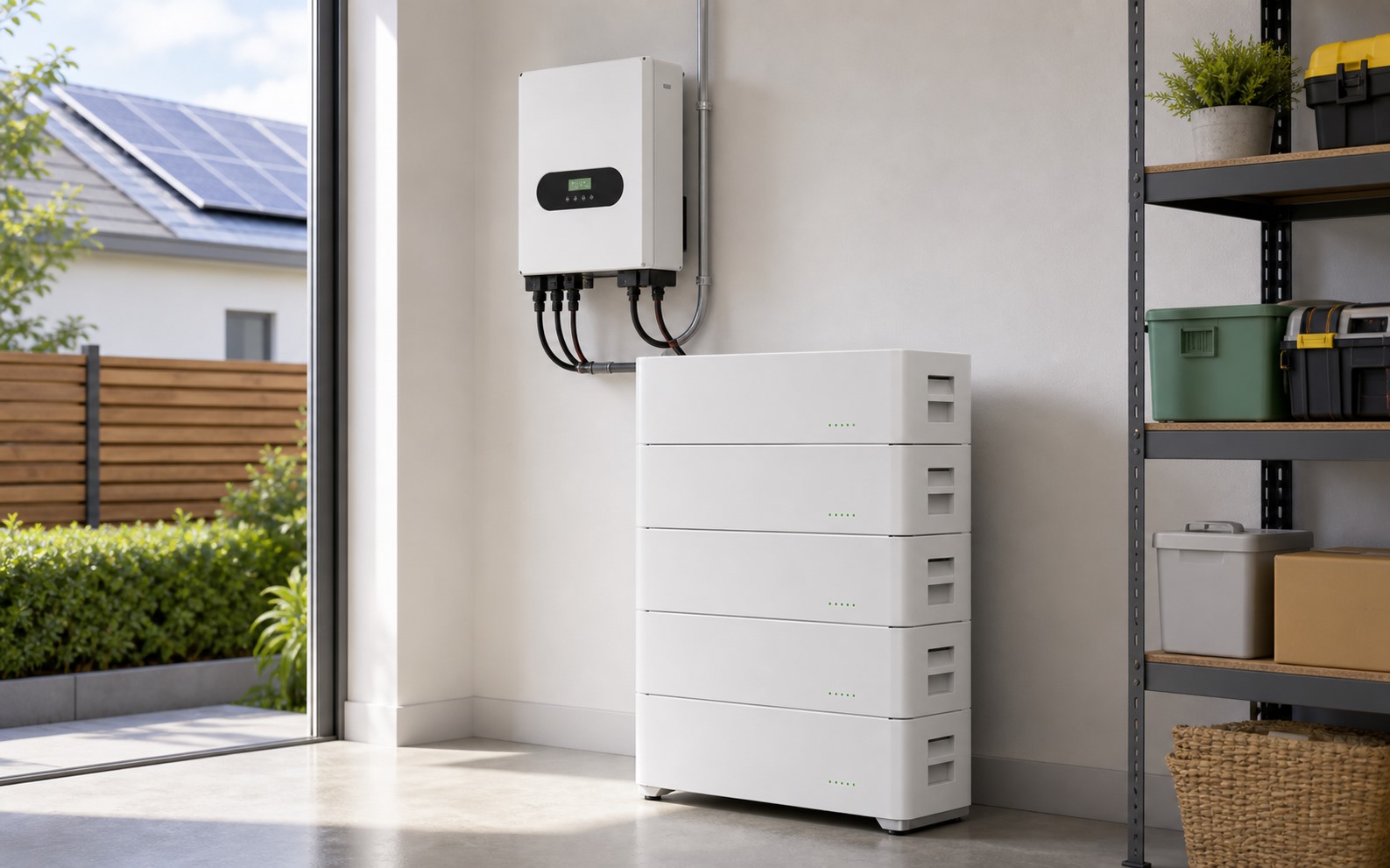
Typical residential recommendation: 8-10kW PV array + 10-15kWh LiFePO4 stackable battery + 8-10kW hybrid inverter with built-in EPS (emergency power supply)
Sizing guide: commercial (50-200kWh)
Commercial solar-plus-storage serves two primary use cases:
- Demand charge reduction — Commercial electricity tariffs often include demand charges based on peak 15-minute power draw. A 50-100kWh battery can shift load to reduce peak demand by 30-50%, delivering ROI in 3-5 years
- Backup power — For businesses where power interruption is costly (manufacturing, data centers, cold storage), a backup system sized to cover critical loads for 4-8 hours provides resilience
Typical commercial recommendation: 30-50kW PV array + 50-100kWh battery stack + 30-50kW hybrid inverter + energy management system (EMS) with demand response capability
Key specifications when evaluating hybrid inverters
Not all hybrid inverters are created equal. Key specs to evaluate:
- MPPT efficiency — Look for 99%+ MPPT efficiency; this directly affects annual energy harvest
- Battery round-trip efficiency — 95%+ for quality units; affects overall system efficiency
- Grid code certifications — Must match the target market's interconnection requirements (CE for EU, NRS-097 for South Africa, etc.)
- EPS (Emergency Power Supply) capability — If backup is needed, the inverter must be capable of islanding from the grid and forming a stable AC output within 20ms of grid failure
- Battery compatibility — Some inverters are designed for specific battery brands; others support multi-brand CAN bus communication. Check the approved battery compatibility list
- Overload capacity — Inverter's ability to handle motor startup loads and surge currents without tripping
SUNFULL solar-storage integrated solutions
Our product line covers the full sizing range:
- 3-10kW hybrid inverters — For residential systems; dual MPPT, 150V-550V PV input range, CAN bus for third-party battery integration; IP65 rated for outdoor installation
- 10-20kW hybrid inverters — For large residential and small commercial; three-phase output option
- 5-35kWh stackable LiFePO4 BESS — High-voltage architecture (51.2V-512V), CAN bus + RS485 communication, IP54 rated; compatible with major hybrid inverter brands
- 20-100kW hybrid inverter systems — For commercial and industrial installations; integrated EMS, AFCI, and anti-islanding protection
- Off-grid solar systems — Pre-configured solar-plus-storage kits for remote sites, telecom towers, and rural electrification; 3kW to 100kW configurations
All SUNFULL hybrid inverters carry CE, IEC 62109-1/2, and VDE-AR-N 4105 (or equivalent) certifications, with grid code parameters configurable for EU, UK, South Africa, Australia, and other major markets.