Short answer
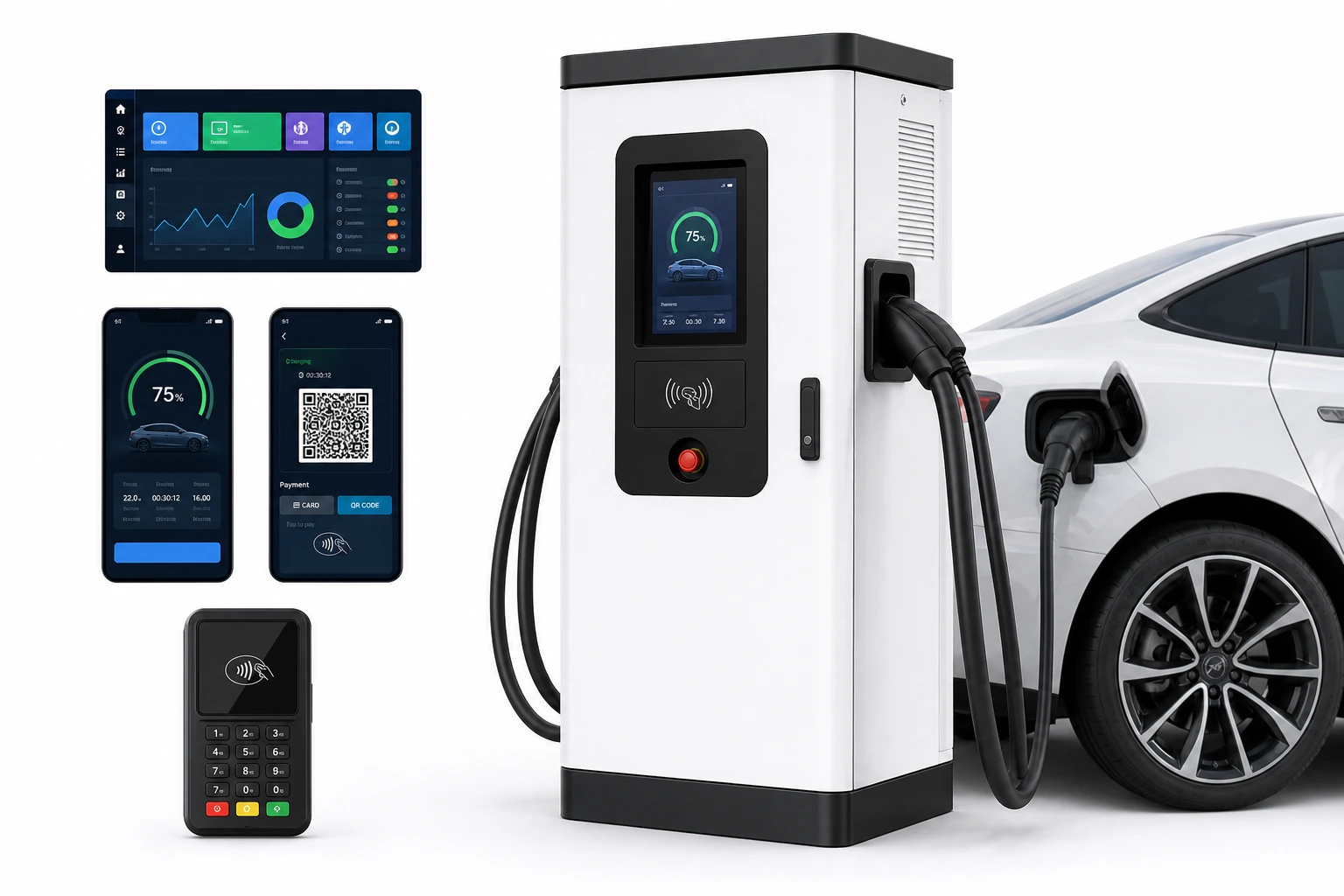
Commercial EV charging payment is not only a charger feature. It is a workflow across charger hardware, OCPP messages, CSMS software, user access, payment provider, tariff rules and settlement. RFID works well for fleets and member access; QR or app payment fits many parking and regional payment flows; POS or card terminals are important for public ad hoc charging and some regulated markets.
Payment methods compared
| Method | Best fit | Buyer checks |
|---|---|---|
| RFID card | Fleet depots, workplaces, hotels, private parking and membership charging. | Card type, user whitelist, offline behavior, lost card process and monthly report. |
| QR code | Parking lots, malls, restaurants and markets where mobile payment is common. | Payment provider, landing page, session matching and receipt workflow. |
| Mobile app | CPO networks, branded charging services and member programs. | User account, wallet, roaming, tariff display and app-to-CSMS integration. |
| POS / card terminal | Public charging, highway stations and regulated ad hoc charging sites. | Terminal provider, PCI scope, settlement, receipt and local compliance. |
| Fleet account | Bus depots, taxi fleets, logistics and employee charging. | Driver ID, vehicle ID, cost center, schedule and export format. |
How payment connects with OCPP and CSMS
OCPP does not replace a payment provider. It helps the charger and backend exchange authorization, session, meter and status data. The CSMS turns those records into a business workflow: users, tariffs, payment status, reports, alarms and operator controls.
For a paid charging site, the buyer should test the full flow: user selects charger, payment or authorization is accepted, the charger starts, energy is measured, the session stops and the record is exported for settlement.
Payment workflow by site type
| Site type | Practical payment workflow | Useful SUNFULL page |
|---|---|---|
| Fleet depot | RFID or driver account, vehicle group, schedule control and monthly export. | Fleet charging management |
| Mall or parking lot | QR/app payment, optional POS, visible tariff and parking operator reporting. | Commercial EV charger manufacturer |
| Highway station | Ad hoc payment, high uptime, remote monitoring and clear receipt process. | 150kW DC fast charger |
| Hotel or workplace | RFID or guest authorization, controlled access and simple session reports. | AC charger range |
| CPO network | App, RFID, tariff engine, remote monitoring, settlement and export APIs. | OCPP / CSMS platform |
EU AFIR and payment planning
For publicly accessible EV charging in Europe, buyers should check AFIR and the local national implementation. AFIR focuses on ad hoc recharging, meaning drivers should be able to recharge without needing a long-term contract with the operator. For tenders, this can affect whether a POS, card terminal, contactless payment or equivalent widely used payment method is required.
For non-EU markets, similar practical questions still apply: can a visitor start charging without manual staff support, can the operator collect money reliably, and can the session record be matched to the payment record?
PCI DSS and payment responsibility
Payment card processing should be handled with a compliant payment provider and proper security scope. The PCI Security Standards Council defines PCI DSS for environments where payment account data is stored, processed or transmitted. In an EV charging RFQ, clarify whether the charger supplier, CPO platform, POS provider or local operator owns payment compliance and settlement.
Payment RFQ checklist
| RFQ item | What to specify | Why it matters |
|---|---|---|
| Access method | RFID, app, QR, POS, card terminal, fleet account or free charging. | Changes hardware, software and commissioning scope. |
| Tariff model | Price per kWh, time fee, idle fee, member price or fleet settlement. | CSMS and receipt data must match the business model. |
| Payment owner | Local operator, CPO platform, payment gateway or POS provider. | Determines compliance, fees, settlement and support responsibility. |
| OCPP workflow | Authorization, transaction record, meter values and payment status mapping. | Prevents paid sessions from becoming manual accounting work. |
| Reports | Daily revenue, session export, tax receipt, charger utilization and exceptions. | Needed for commercial operation after launch. |
Buyer warning
Do not compare payment-ready chargers only by hardware price. A lower quote may exclude POS terminal, SIM, local payment gateway integration, receipt workflow, tariff configuration or remote acceptance testing.
FAQ
Which payment method is best for commercial EV charging stations?
The best payment method depends on the site model. Fleet depots often use RFID or accounts, parking operators may use QR or app payment, and public charging sites may need POS or card terminal options depending on local regulation.
Does OCPP handle payment by itself?
OCPP can carry authorization, transaction and meter data, but the full payment workflow depends on the CSMS, payment provider, POS hardware, local compliance and settlement process.
Do EU public charging stations need card payment?
EU AFIR rules require ad hoc recharging access for publicly accessible stations, and buyers should check the latest local implementation for card, contactless or other widely used payment options.
What should buyers include in an EV charging payment RFQ?
Include site type, country, charger power, OCPP or CSMS platform, user access method, payment method, receipt needs, tariff rules, settlement owner and whether payment hardware is included.
Official references
These first-party legal, payment-security and protocol sources support the general workflow described here. They do not certify SUNFULL or any specific charger.
Related SUNFULL pages
Project review checklist
Choose payment from the complete driver journey
User group
Identify fleet drivers, employees, members, guests or anonymous public users.
Start and settlement flow
Define authorization, tariff display, session matching, receipt, refund or failure handling and settlement owner.
Hardware and backend
Confirm RFID reader, QR or app, POS terminal, OCPP or CSMS and payment-provider integration.
Compliance boundary
Assign payment security, local ad-hoc charging, tax receipt and support responsibility; confirm per market/project.
Need a payment-ready charger quote?
Send your country, site type, charger power, access method, payment provider and OCPP/CSMS requirement. SUNFULL can help define the charger and software scope before quotation.
Plan commercial payment scope Request POS charger quote WhatsApp payment workflow
Send payment and user-access requirements
Share site type, charger model, user group, payment method, CSMS, market and quantity. SUNFULL can review charger hardware and backend scope.
Payment scope should be decided before hardware order
Payment is not only a button on the charger. It affects screen design, user authorization, transaction record, receipt flow, backend integration, local payment provider and after-sales responsibility.
Public sites need a complete user journey
A buyer should define how a driver starts charging, how payment is authorized, what happens if the session fails, how receipts are issued and how support handles disputes. This should be written before shipment.
Fleet and private sites may not need POS
For depots, workplaces and apartments, RFID or backend billing may be simpler than a POS terminal. The right choice depends on whether users are known and whether revenue is collected from the public.
Buyer FAQ
Is RFID enough for commercial EV charging?
RFID can be enough for fleet, workplace or member sites. Public charging may need QR, app, POS or other payment workflows.
Can payment work with OCPP?
Payment workflows often connect with a CSMS through OCPP-related session and authorization logic, but the exact integration depends on backend and payment provider.
What should I send for payment configuration review?
Send charger model, site type, user group, payment method, target market, CSMS provider and quantity.