Load management EV charging scope
For buyers researching load management EV charging, document the site limit, meter or CT source, charger groups, allocation priority, update interval and safe behavior after a communication loss.
Supplier support for AC wallbox and DC fast charger projects that require OCPP 1.6J, OCPP 2.0.1, CSMS testing, RFID, QR/POS payment, remote monitoring and fleet management.
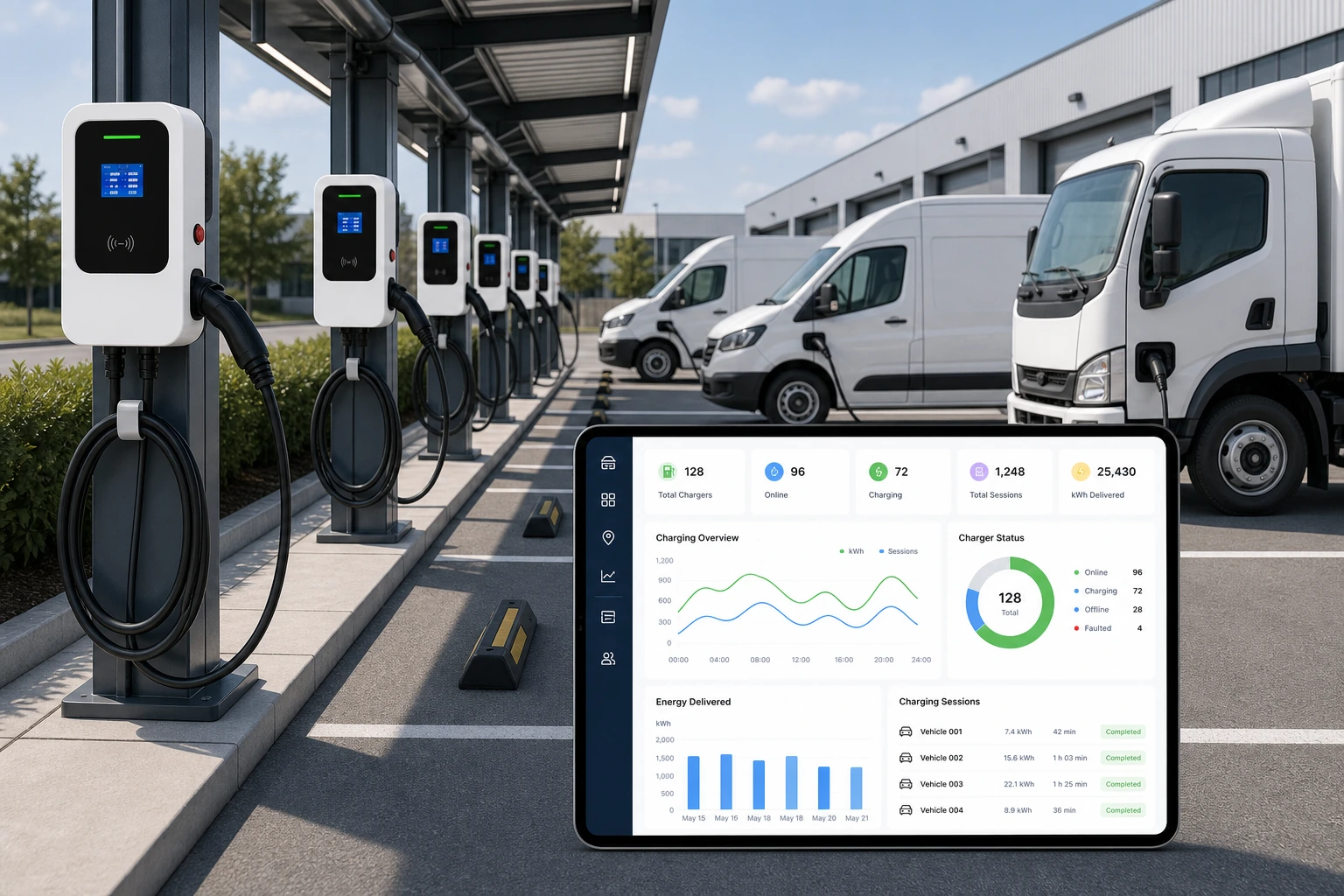
OCPP compatibility should be tested before batch orders. Share charger type, protocol version, backend platform, payment method, SIM/network plan, authorization workflow and target market so we can confirm the correct AC/DC charger configuration.
For operator projects, backend testing is a procurement step, not an afterthought after shipment.
An OCPP EV charger supplier should confirm the protocol version by exact charger model and firmware, then test the target CSMS connection before a batch order. The RFQ should define backend URL, charger identity, security profile, network method, authorization, meter values, remote commands, alarms, firmware actions, payment flow and reporting; support is confirmed per model/project.
Confirm OCPP 1.6J, OCPP 2.0.1 or both for the exact charger and firmware.
Provide backend URL or test account, charger identity rules, security profile and acceptance-test list.
Define authorization, start and stop, meter values, alarms, reset, firmware actions, reports and user roles.
Clarify RFID, app, QR or POS flow and whether the CSMS, gateway, operator or charger owns each responsibility.
Confirm OCPP 1.6J or 2.0.1 requirements, charger model scope, backend URL setup and connection testing before batch supply.
Manage chargers, sites, users, tariffs, alerts, sessions and reporting through an operator-ready charging management workflow.
Review RFID, app, QR, POS, user account, fleet card and paid public charging requirements before confirming the software scope.
For distributors and OEM brands, confirm dashboard branding, language, domain, user roles, API access and support responsibilities.
Cloud charging station management for OCPP chargers: site monitoring, authorization, billing, payment workflow, API and white-label operator support.
Protocol scope: OCPP 1.6J / OCPP 2.0.1 by charger model
Use cases: fleet depot, commercial parking, public CPO network
RFQ focus: backend testing before batch orders
Use this checklist before asking an OCPP software supplier or EV charger manufacturer for a quotation.
| Topic | What to Confirm | Why It Matters |
|---|---|---|
| OCPP version | OCPP 1.6J, OCPP 2.0.1 or both; confirm version by exact charger model and firmware. | Commercial networks need stable backend communication, not only a protocol label. |
| CSMS connection | Backend URL, charger identity, security profile, certificates, test account and acceptance test plan. | Reduces integration risk before importers or CPOs commit to a batch order. |
| Operation workflow | Remote start/stop, authorization, meter values, alarms, remote reset, firmware actions and reporting. | These functions decide whether the charger can be operated after installation. |
| Payment and users | RFID, app account, QR code, POS, fleet card, tariff plan, receipts and transaction export. | Payment and access rules differ for fleet, parking, mall and public charging sites. |
| Data and API | Site hierarchy, user roles, energy reports, session exports, API needs and white-label dashboard scope. | Important for distributors, OEM brands and multi-site charging operators. |
Record the exact charger model, firmware, protocol version, target CSMS and test date. A protocol label alone does not confirm that the required operating workflow has passed end-to-end testing.
| Acceptance area | Charger or firmware scope | CSMS or third-party scope | Evidence before batch approval |
|---|---|---|---|
| Connection and identity | Endpoint settings, charger identity, firmware and reconnect behavior. | Device registration, endpoint access and identity rules. | Dated connection log for the quoted charger and target CSMS. |
| Authorization and sessions | Connector status, authorization handling, transaction start/stop and meter values. | User or RFID records, tariff logic, session records and operator controls. | Agreed test cases with results for required transaction flows. |
| Remote operation | Remote commands, reset behavior, charging profiles and fault reporting supported by the selected firmware. | Command interface, permissions, alerts and audit trail. | Command and alarm records showing expected and failed-case behavior. |
| Payment and access | Charger-side reader, display, QR or terminal interface where included. | Payment gateway, app, tariff, receipt, settlement and account responsibilities. | Documented payment path and responsible system for each step. |
| Load management | Charger response to power limits and safe behavior after communication loss. | Site limit, allocation rules, meter or CT input and priority logic. | Load-allocation test using the planned controller or CSMS. |
| Acceptance closeout | Final model, firmware, configuration export and shipment setting. | Production environment, user roles, reporting and support handover. | Signed acceptance record plus retained logs and configuration versions. |
Prioritize charger uptime, schedule windows, load management, driver authorization and energy reports.
Prioritize payment, tariff rules, availability display, fault alerts and transaction records.
Prioritize tested charger models, repeatable firmware settings, white-label scope and support handover.
| Buyer phrase | Clarify in the RFQ | Where to continue |
|---|---|---|
| OCPP EV charger supplier | Charger model, OCPP version, backend URL, security profile, SIM or Ethernet, and acceptance tests. | AC charger range or DC fast charger range |
| CSMS EV charging platform | Site hierarchy, tariff rules, user roles, payment records, reporting, API and white-label dashboard needs. | CSMS planning guide |
| OCPP 2.0.1 DC charger | Exact firmware, meter values, remote reset, charging profile, TLS/security profile and test-account workflow. | OCPP 2.0.1 DC checklist |
| Payment-ready OCPP charger | RFID, app, QR, POS, receipt, settlement report and whether payment is handled by CSMS or external gateway. | POS payment EV charger |
Include the target CSMS name and version, OCPP version, charger model and quantity, required messages and functions, SIM/Ethernet/Wi-Fi method, security profile, authorization and payment workflow, load-management rules, remote-maintenance needs and acceptance environment. These inputs allow the supplier, platform provider and operator to assign responsibility before testing.
Use the OCPP backend testing checklist or continue to the EV charger manufacturer evidence guide.
Get factory-direct pricing, datasheet, and technical support after project-scope review.
Also browse our 30 Smart Charging Hub products: 7kW Smart EV Charger with OCPP 1.6 + 4G • 22kW Smart EV Charger WLAN + 4G + Bluetooth • 100kW Fleet Charging Station with OCPP 2.0
Short answers for buyers comparing OCPP-ready AC/DC chargers, CSMS integration, payment workflow and operator testing.
OCPP is the communication protocol between EV chargers and a charging management platform. It supports remote monitoring, authorization, billing, fault reporting, firmware actions and charging-session data.
A CSMS is a charging station management system used by operators to manage chargers, users, tariffs, payments, sessions, alarms, firmware and reporting across one or many charging sites.
OCPP 1.6J is widely used and practical for many commercial networks. OCPP 2.0.1 is better for newer projects that need stronger device management, security and future-ready smart charging functions.
Test charger connection, authorization, start/stop transaction, meter values, fault alarms, remote reset, firmware actions, payment flow and reporting with the target CSMS before batch orders.
Send charger type, power rating, connector standard, target OCPP version, CSMS provider, backend URL or test account, security profile, network method, payment workflow, quantity, market and certification needs.
Provide the target CSMS, available test access, charger identity rules and acceptance criteria. Feasibility, supported checks and responsibilities are confirmed for the selected charger model and project before any test commitment.
Payment scope depends on the project. Some sites use RFID or app authorization through the CSMS; public charging sites may also need QR, POS, tariff rules, receipts and settlement reports.
This must be defined in the RFQ. A project may use the buyer's existing CSMS, a third-party platform or a separately agreed platform scope. Confirm platform ownership, charger and firmware compatibility, test access, required functions, data ownership and ongoing support before placing a batch order.
Fleet charging management / CPO platform • OCPP backend testing checklist • RFID / QR / POS payment guide • CPO tariffs and revenue guide • OCPP 1.6J vs OCPP 2.0.1 guide • ISO 15118 / DIN 70121 guide • Fleet DC charger with OCPP • Commercial EV charger manufacturer • DC fast charger manufacturer • Product catalog
Use these pages together to define protocol version, backend, authentication, payment, load management and acceptance testing before ordering chargers.
Compare protocol, backend, security and acceptance scope before ordering chargers.
Choose protocol scope by backend functions and lifecycle requirements.
Verify connection, meter values, remote commands, alarms and firmware.
Plan charging windows, transformer capacity, priority and managed load.
Match vehicles, dwell time and daily energy to charger power and quantity.
Define authorization, tariff and settlement workflows before integration.
EV charging station management software should be evaluated against actual user authorization, tariffs, payments, charger groups, alarms, firmware, reporting and support ownership. A protocol label alone does not prove that the required end-to-end workflow has been tested.
For buyers researching load management EV charging, document the site limit, meter or CT source, charger groups, allocation priority, update interval and safe behavior after a communication loss.
An EV charging load management test should show how power is allocated when vehicles connect, disconnect, reach a target or become unavailable, including what the operator can see in the platform.
Define whether the EV charger load management system logic sits in a local controller, the charger network, the CSMS or a combination, and assign ownership for configuration and fault diagnosis.