Short answer
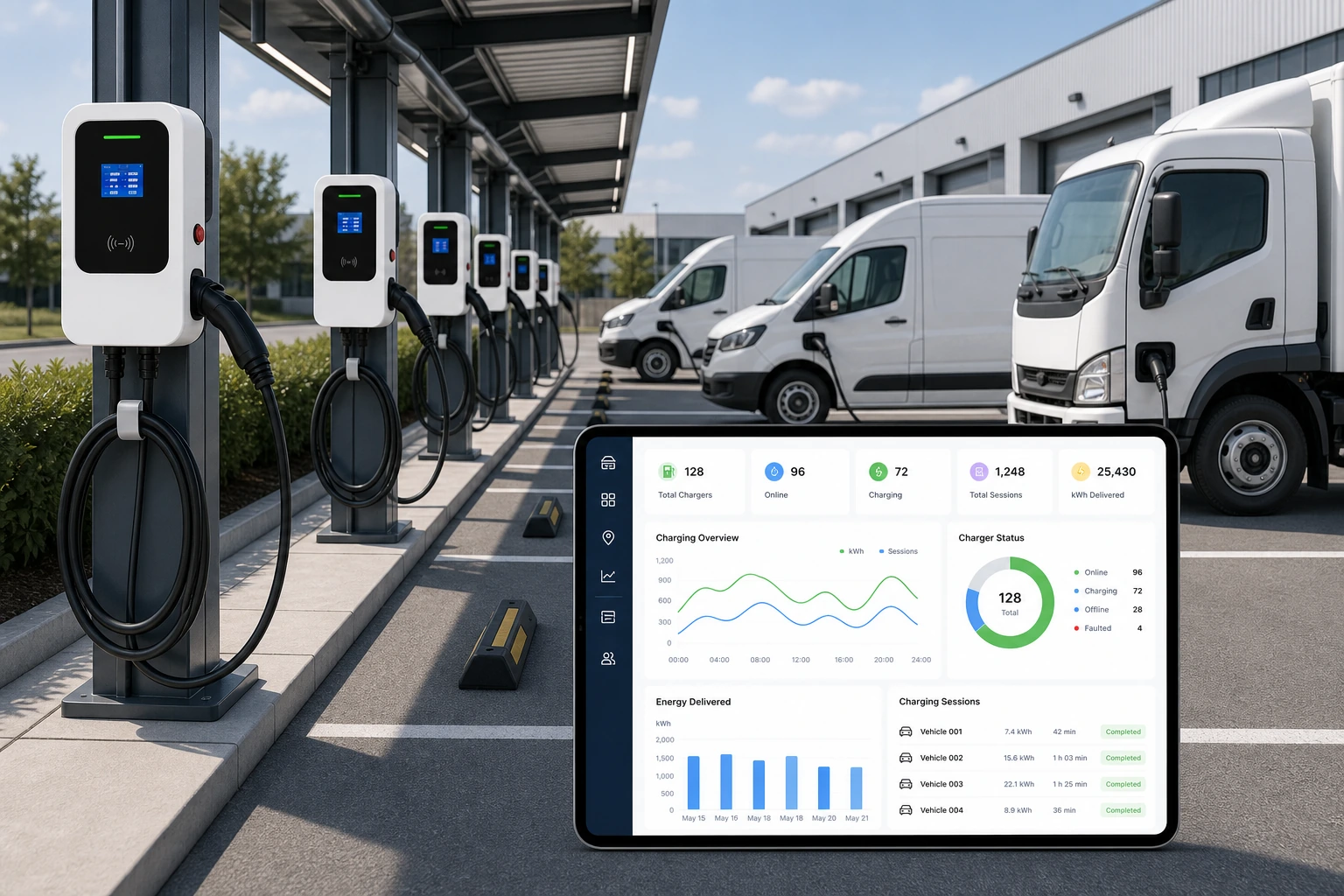
CSMS stands for charging station management system. It is the software layer that lets operators monitor chargers, manage users, set tariffs, collect session records, handle alarms, connect payment workflows and run charging stations remotely. OCPP is the communication protocol; CSMS is the operating platform.
Why CSMS matters for commercial buyers
Buyers asking about CSMS EV charging and CSMS charging are usually trying to understand software operation, not only hardware. For commercial charging, the charger must work as part of a network: it needs user control, payment, fault handling, reports and maintenance visibility.
A charger can look correct on the cabinet specification but still fail the project if backend connection, payment workflow or remote support is not tested before shipment.
CSMS functions buyers should ask about
| Function | What it does | Buyer question |
|---|---|---|
| Charger monitoring | Shows online status, connector status, alarms and meter values. | Can the operator view every charger and connector remotely? |
| User authorization | Supports RFID, app, account, QR or other access methods. | Which authorization methods are supported by the exact charger model? |
| Tariff and billing | Sets price rules and records charging sessions. | Can the platform support the local payment and reporting workflow? |
| Remote maintenance | Supports reset, diagnostics, firmware and fault review. | Which actions can be done without visiting the site? |
| Reports | Exports sessions, revenue, uptime and energy data. | Can data be exported for the operator's accounting or CPO system? |
CSMS vs OCPP
OCPP is the open protocol that connects chargers to backend software. CSMS is the backend system that manages daily operation. In an RFQ, buyers should specify both: the OCPP version required and the CSMS workflow that the charger must pass.
For DC charging projects, do not confuse CSMS with the vehicle communication layer. ISO 15118 and DIN SPEC 70121 are used between the EV and charger, while CSMS receives operating data through OCPP.
| Item | OCPP | CSMS |
|---|---|---|
| Role | Communication protocol | Charging management platform |
| Main buyer concern | Compatibility and message support | Operation, users, tariffs, reports and maintenance |
| Example question | Does the charger support OCPP 1.6J or 2.0.1? | Can the operator start, stop, bill and monitor sessions? |
| Project risk | Protocol listed but not tested with target backend | Workflow does not match local operation model |
CSMS, OCPP, RFID and payment workflow
Commercial buyers often mix these terms together, but they solve different parts of the operation. The charger needs to communicate with the backend, the backend needs to manage business rules, and users need a way to start and pay for a session.
| Layer | Example function | RFQ detail to confirm |
|---|---|---|
| OCPP charger | Connector status, meter values, transaction messages and remote commands. | OCPP version, firmware version and backend test plan. |
| CSMS platform | Users, tariffs, reports, alarms, charger grouping and operator dashboard. | SUNFULL platform, buyer platform or third-party CPO platform. |
| Access control | RFID card, app account, QR code, free charging or fleet-only login. | Who can start charging and how users are authorized. |
| Payment | POS, credit card terminal, QR payment, wallet or offline settlement. | Whether payment hardware and local payment workflow are included. |
When a project needs CSMS
- Public charging stations that require paid charging and user records.
- Fleet depots that need schedule control and driver authorization.
- Parking lots, malls and hotels that need charger status and revenue reports.
- Distributors or operators managing chargers across multiple sites.
- OEM projects where the buyer needs brand-specific software workflow.
CSMS fit by charger type
CSMS requirements are different for AC destination charging and DC fast charging. A hotel AC charger may only need app or RFID control, while a public DC fast charging station may need connector-level billing, fault alerts, firmware management and uptime reports.
| Charger type | Typical CSMS need | Related guide |
|---|---|---|
| AC wallbox | User access, app view, RFID, simple reports and remote status. | AC charger range |
| Commercial AC charger | Site grouping, employee or visitor access, billing records and basic remote maintenance. | Commercial EV charger manufacturer |
| DC fast charger | Connector status, payment workflow, alarms, meter data, firmware and uptime monitoring. | DC fast charger page |
| Fleet DC charger | Driver authorization, charging schedule, depot reports and remote troubleshooting. | Fleet DC charger with OCPP |
RFQ checklist for CSMS EV charging projects
| RFQ item | What to confirm | Why it matters |
|---|---|---|
| Backend target | SUNFULL platform, buyer platform or third-party CPO platform. | Integration scope changes by backend owner. |
| OCPP version | OCPP 1.6J, OCPP 2.0.1 or both. | Defines message set, security and future roadmap. |
| Payment method | RFID, QR, app, POS, credit card terminal or free charging. | Payment hardware and software workflow must match. |
| Network method | Ethernet, 4G, WiFi or site-specific network plan. | Commercial uptime depends on stable connection. |
| Test process | Remote connection test, transaction test and acceptance checklist. | Reduces integration risk before shipment. |
Procurement tip
Do not treat CSMS as a logo on a brochure. Ask for a tested workflow: charger boot, backend connection, authorization, charging start, meter value upload, stop transaction, payment record, alarm and remote reset.
Questions to ask before a pilot order
- Which charger models and firmware versions have been tested with the target CSMS?
- Can the supplier run a remote demo with the buyer's backend before shipment?
- How are tariff rules, taxes, receipts and settlement handled?
- Can alarms, offline events and connector faults be exported?
- Who provides support if the charger connects to a third-party CPO platform?
FAQ
What is CSMS in EV charging?
CSMS means charging station management system. It is the software platform that manages chargers, users, pricing, sessions, alarms, payments, reports and remote operation.
Is CSMS the same as OCPP?
No. OCPP is the communication protocol between charger and backend. CSMS is the backend software platform that uses OCPP data to manage charging operations.
Do commercial EV chargers need CSMS?
Commercial chargers usually need CSMS when they are used for paid charging, multi-site operation, user authorization, remote maintenance, reports or operator dashboards.
What should buyers test before ordering OCPP chargers?
Buyers should test backend connection, charger identity, start and stop transaction, RFID or payment workflow, meter values, alarms, remote reset and firmware workflow before batch orders.
Related SUNFULL pages
Need CSMS compatibility checked?
Share your target backend, payment method, charger model, country and operation workflow. SUNFULL can help define the OCPP and CSMS test scope before quotation.
What should buyers confirm before connecting chargers to a CSMS?
A CSMS manages charger status, users, sessions, tariffs, reports and remote commands. Buyers should confirm OCPP version, charger ID, security profile, RFID or payment method, network connection, test account and report needs before ordering hardware.
AC wallbox or DC fast charger model, firmware version, network method and charger identity.
OCPP version, CSMS URL, authorization method, tariff rule, remote commands and report export.
Pre-shipment connection test, transaction test, meter values, fault reporting and support handover.
Send charger and CSMS requirements for review
Share charger model, OCPP version, backend URL if available, RFID/payment needs, country and quantity. We can map the hardware and CSMS test scope.
CSMS readiness is more than protocol support
A charger can support OCPP but still need the right charger ID, endpoint format, authorization workflow, tariff setting and network method before it works smoothly with the target CSMS. Buyers should define the operation workflow in the RFQ.
Testing should happen before shipment
For fleet, CPO and commercial parking projects, pre-shipment CSMS testing helps catch backend connection, RFID, transaction, meter and fault-reporting issues before chargers reach the site.
Keep handover records
Save firmware version, charger ID, backend endpoint, network setting, test screenshots and support contacts with the purchase file. These records make future troubleshooting much faster.
Buyer FAQ
Is CSMS the same as OCPP?
No. OCPP is the communication protocol, while CSMS is the management system that monitors and controls chargers.
Do all commercial chargers need a CSMS?
Many commercial sites need a CSMS for users, reports, tariffs and remote support, but the scope depends on the business model.
What should I send for CSMS compatibility review?
Send charger model, OCPP version, backend URL if available, authorization method, payment needs, network method and quantity.