Short answer
OCPP 1.6J is still widely used and is usually enough for many commercial charging projects. OCPP 2.0.1 is stronger for future-ready networks because it improves security, device management and ISO 15118 related functions. The Open Charge Alliance also lists OCPP 2.1 for newer advanced use cases, but most RFQs still compare 1.6J and 2.0.1 first. Buyers should not only ask which version is listed; they should ask which backend platforms have been tested.
What OCPP means for buyers
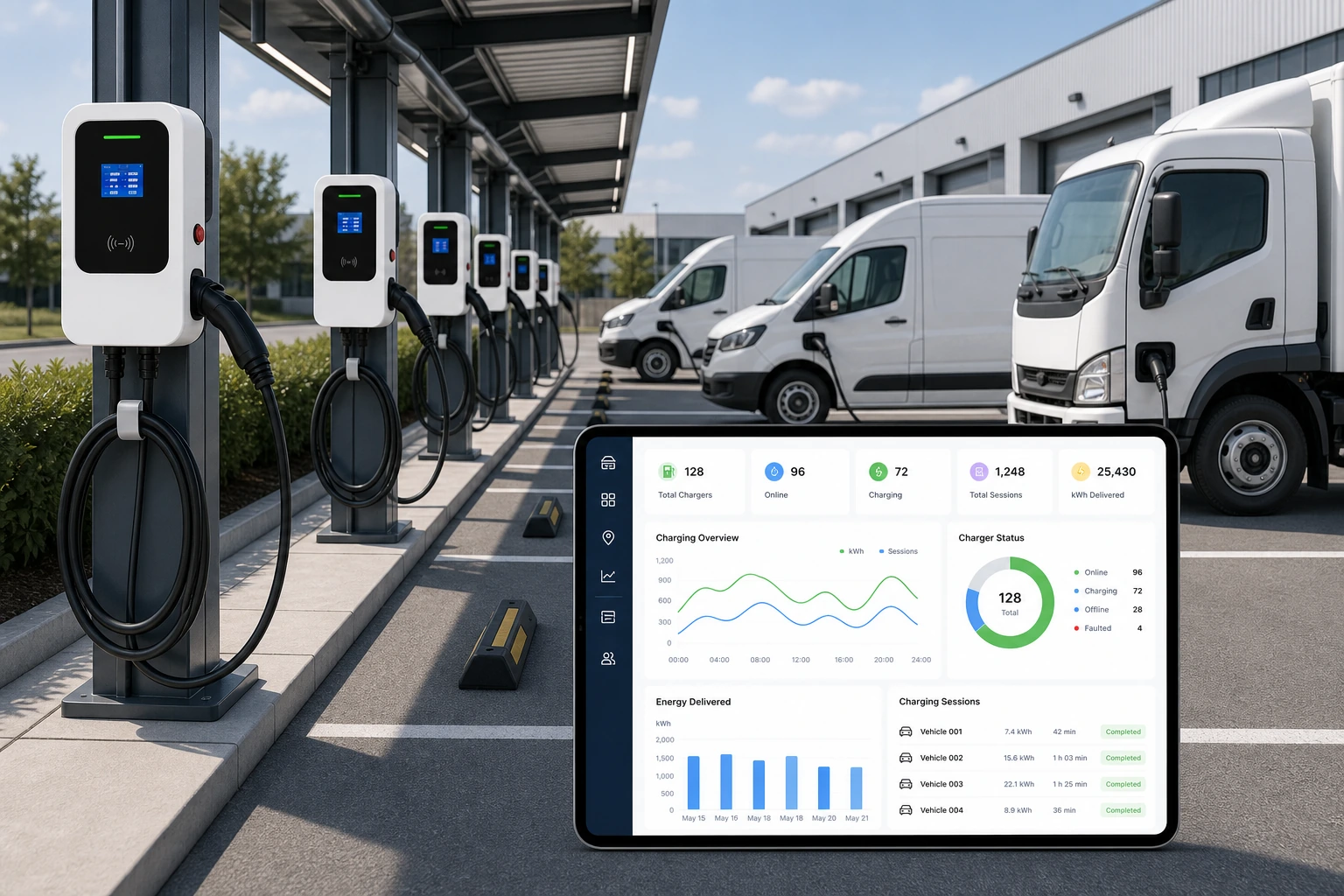
OCPP is the communication protocol between the charger and the charging management platform. It affects remote monitoring, billing, user authorization, firmware updates, fault reports and operating data. For a distributor or CPO, OCPP compatibility can decide whether the charger is easy to operate after installation.
OCPP version positioning for procurement
For procurement work, treat OCPP as a tested integration requirement, not a marketing label. A charger model, firmware version, security profile and backend platform must be checked together. This is especially important for public charging stations, fleet depots, paid charging and multi-site CPO operation.
| Topic | OCPP 1.6J | OCPP 2.0.1 |
|---|---|---|
| Market adoption | Very common globally | Growing in tenders and newer networks |
| Core charging control | Good for most commercial use | More detailed device and transaction handling |
| Security | Depends on implementation | Stronger security model and certificate handling |
| Future readiness | Good for stable networks | Better for advanced CPO requirements |
| Best buyer fit | Distributors, fleet sites and standard commercial deployments | CPO tenders, newer networks and stricter backend operation |
OCPP vs CSMS vs payment workflow
OCPP is not the same as CSMS. OCPP is the protocol language. The CSMS is the software platform that manages chargers, users, tariffs, payment records, alarms and reports. Payment is a separate workflow that may involve RFID, app, QR, POS or credit card terminal integration.
Also separate OCPP from vehicle-to-charger protocols. ISO 15118 and DIN SPEC 70121 sit between the EV and charger; OCPP sits between the charger and the backend platform.
| Layer | Role | What the buyer should verify |
|---|---|---|
| Charger hardware | Cabinet, connector, meter, controller and power modules. | Power level, connector standard, IP rating, cable length and protection design. |
| OCPP protocol | Message exchange between charger and backend. | OCPP version, security profile, meter values, transaction and remote command support. |
| CSMS platform | Daily operation and network management. | User management, pricing, reports, alarms, firmware and multi-site dashboard. |
| Payment workflow | How users start, pay and receive session records. | RFID, app, QR, POS, card terminal, tax receipt and local operator process. |
Questions to ask before purchase
- Is the charger tested with my target backend platform?
- Can the supplier provide OCPP test logs or remote demonstration?
- Can firmware be updated remotely after deployment?
- Does the charger support RFID, app, QR code, POS or credit card workflows?
- Who handles backend integration if the local CPO platform is different?
- Does the charger use the required connector standard for the target vehicles?
- Can the supplier provide a pre-shipment remote OCPP test session?
OCPP / CSMS RFQ checklist
For Ads and search queries such as OCPP EV charger, CSMS EV charging and OCPP cloud platform, the buyer usually needs an operating answer, not only a protocol name. Put these details in the RFQ before comparing charger suppliers.
| RFQ item | What to ask | Why it matters |
|---|---|---|
| Protocol version | OCPP 1.6J, OCPP 2.0.1 or both; confirm by exact charger model and firmware. | Some suppliers list OCPP generally, but support differs by SKU and software version. |
| CSMS platform | Target backend URL, test account, charger identity, security profile and acceptance test plan. | Commercial buyers need evidence that the charger can connect to the intended platform. |
| Payment workflow | RFID, app account, QR payment, POS, tariff rules, receipts and transaction export. | Paid public charging needs a complete operating workflow after installation. |
| Remote operation | Remote start/stop, reset, firmware, alarms, meter values, availability and reporting. | These functions affect uptime, maintenance and multi-site operation. |
When OCPP 1.6J is enough
For many distributors, private parking operators, small CPO networks and fleet depots, OCPP 1.6J is a stable and practical choice. It is easier to integrate with many existing platforms and can support common functions such as authorization, transaction record, charger status and remote reset.
When OCPP 2.0.1 is worth specifying
OCPP 2.0.1 should be considered when the buyer is building a long-term commercial network, needs stricter security, expects advanced energy management or has a tender requirement. It is also useful when the project roadmap includes ISO 15118 features or more advanced smart charging control.
How OCPP affects AC and DC charger selection
AC chargers may only need simple authorization and session records, while DC fast chargers often need connector-level status, remote diagnostics, payment records and higher uptime control. Before choosing AC vs DC chargers, define whether the site will operate as free private charging, controlled fleet charging or paid public charging.
Procurement warning
A datasheet line that says "OCPP supported" is not enough. Ask the supplier which exact version is supported, which backend has been tested, whether logs can be provided and whether remote commissioning is included.
FAQ
Is OCPP 1.6J still enough for commercial EV charging?
OCPP 1.6J is still enough for many commercial charging sites when the buyer needs stable remote monitoring, authorization, transaction records and basic charger control with a widely supported CSMS platform.
When should a buyer specify OCPP 2.0.1?
OCPP 2.0.1 is worth specifying when the project needs stronger device management, security profiles, future-ready smart charging, ISO 15118 roadmap support or tender requirements for newer network functions.
What should buyers test before importing OCPP EV chargers?
Buyers should test backend connection, authorization, start and stop transaction, meter values, remote reset, fault alarms, firmware workflow, payment or RFID logic and reporting with the target CSMS before batch orders.
Is a CSMS platform the same as OCPP?
No. OCPP is the communication protocol. A CSMS is the charging station management system that uses the protocol to manage chargers, users, pricing, payments, alarms, reports and remote operation.
Related SUNFULL pages
Need OCPP confirmation before importing?
Send your target backend platform, payment method and charger model. SUNFULL can confirm the practical integration path before quotation.
Should a buyer choose OCPP 1.6J or OCPP 2.0.1?
Choose the OCPP version that matches the target CSMS, tender requirement, security need and launch schedule. OCPP 1.6J remains common and stable, while OCPP 2.0.1 can fit projects needing stronger device management and security functions.
Established CSMS platforms, faster commercial launch and many common AC/DC charger projects.
Tender-driven projects, advanced device management, stronger security workflow and future network planning.
Ask for exact model support, firmware version, security profile, CSMS test evidence and acceptance workflow.
Send your CSMS and OCPP version requirement
Share charger model, target backend, OCPP version, security profile, RFID/payment needs and quantity. We can review the practical test path.
Do not choose OCPP 2.0.1 only because it sounds newer
The newer protocol may be useful, but the project still depends on CSMS compatibility, firmware readiness, test evidence and launch timeline. If the target backend is mature on OCPP 1.6J, that may be the faster path.
Write the acceptance workflow before ordering
The buyer, CSMS provider and charger factory should agree on boot, heartbeat, status, authorization, transaction, meter values, remote command, fault reporting and report export tests before the batch is approved.
Version choice affects support handover
Ask who handles backend credentials, certificate handling, endpoint format, firmware updates and troubleshooting. These details matter more than a one-line protocol claim.
Buyer FAQ
Is OCPP 2.0.1 always better than OCPP 1.6J?
No. It depends on CSMS support, project requirement and launch schedule. OCPP 1.6J is still widely used.
Can one charger support both OCPP versions?
Some models may support more than one version, but buyers should confirm exact model and firmware support before ordering.
What should I ask the supplier for OCPP proof?
Ask for firmware version, backend test evidence, supported functions, security profile and pre-shipment acceptance procedure.