100kW Fleet Charging Station for Depot and Logistics Projects
Plan 100kW charging, OCPP/CSMS, load scheduling, RFID driver access, payment options and maintenance scope before fleet rollout.
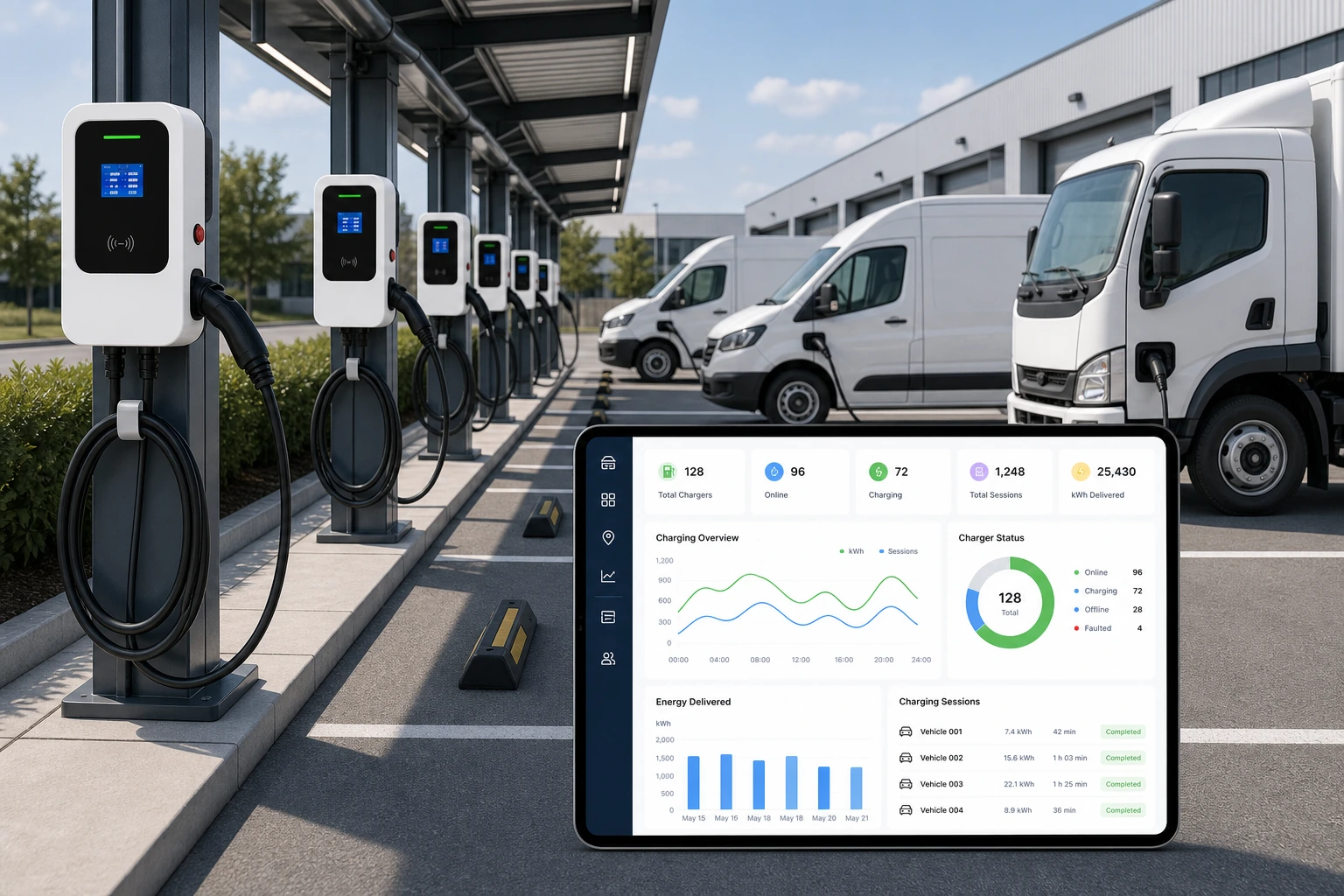
What should a buyer confirm for a 100kW fleet charging station?
Start with the vehicles and charging window. Confirm whether the proposed 100kW output and dual-gun power behavior match route turnaround, then define site supply, connector scope, OCPP/CSMS, RFID access, maintenance access and the quotation boundary.
| Decision | Buyer input | Supplier confirmation | Boundary |
|---|---|---|---|
| Vehicle demand | Vehicle type, battery size, maximum accepted charging power and daily energy demand | Vehicle acceptance and connector compatibility scope | Do not assume compatibility with every vehicle |
| Charging window | Parking duration, departure schedule and simultaneous sessions | 100kW and dual-gun power behavior for the selected configuration | Confirm against vehicle acceptance and site operation |
| Site supply | Transformer capacity, available input power, other site loads, cable route and expansion plan | Charger electrical input and installation information | Local grid, civil and installation work remain separately defined |
| OCPP and access | CSMS, OCPP version, RFID users, network, logs and remote commands | Supported interface, test method and acceptance responsibility | Do not assume compatibility with an untested platform |
| Quote scope | Quantity, market, documents, Incoterm, spare parts and support | Exact model, options, files and exclusions | Final quotation follows the confirmed configuration |
For site-wide charger mix, capacity allocation and expansion planning, review fleet depot charging infrastructure and capacity planning.
Power mix
Use AC charging for long-dwell vehicles and DC fast charging for route turnaround, buses, taxis and logistics peaks.
Operation workflow
Confirm RFID driver ID, OCPP/CSMS, charging reports, remote reset, alarms and scheduled charging rules.
Site planning
Send depot layout, vehicle count, transformer capacity, charging window and expansion plan before RFQ.
Power Planning
Match 22kW AC, 60-150kW DC and 100kW fleet charging to route schedule, dwell time and available grid power.
Depot Design
Confirm bay count, cable route, charger mounting, vehicle turning radius, service access and future expansion space.
RFID / Payment
Use RFID driver ID for private fleets, or add QR, app or POS payment when chargers serve partners or public users.
OCPP / CSMS
Connect chargers to CSMS for session reports, remote commands, alarms, tariff rules and load management.
Featured: 100kW Fleet Charging Station with OCPP 2.0
Multi-port, OCPP 2.0, load scheduling, billing API, fleet management
Quote: Contact us for a tailored factory quote
Documentation: Compliance files confirmed by exact model and destination market
Lead Time: Confirmed after configuration, quantity and document review
100kW depot operating checks
Start from the vehicle schedule, not from the charger model. A practical fleet charging plan defines route window, charger power, concurrent sessions, RFID/payment workflow, OCPP/CSMS backend, maintenance access and future expansion before price comparison.
Depot Power
Confirm available grid capacity, transformer limits, peak tariff, overnight charging window and whether a BESS buffer is needed.
Driver Access
Private fleets usually need RFID driver or vehicle ID. Mixed-use depots may also need QR, app or POS payment.
Operation Reports
Use CSMS reports for kWh per vehicle, charger uptime, fault records, remote reset and maintenance planning.
How to evaluate 100kW Fleet Charging Station with OCPP 2.0 before ordering
This buyer guide is written for fleet depots, bus operators, logistics yards and high-utilization charging sites. It turns the product page into a practical sourcing checklist, so a procurement team can compare suppliers by project fit rather than only by headline price.
1. Match charger power to the route schedule
Start with the real operating conditions: vehicle type, battery size, route window, parking time, available grid capacity and emergency top-up needs. Use AC for long-dwell vehicles and DC for fast turnaround or high-utilization vehicles.
2. Confirm OCPP, RFID and payment workflow
Before price negotiation is finished, ask how the charger connects to the CSMS, what OCPP version is supported, how RFID cards are issued, whether QR/POS payment is needed, and what session reports the operator can export.
3. Compare the full supply and maintenance scope
Start from the complete supply scope before requesting a tailored quote. Confirm cables, pedestals, backend configuration, RFID cards, spare parts, user labels, packing marks, installation documentation, remote diagnostics and after-sales support.
Depot design
Bay count, parking direction, cable reach, charger position, protection bollards and service access should be decided before the charger model is locked.
Load management
Use site-level power limits, scheduled charging, priority rules and optional battery buffering to avoid unnecessary peak load.
Fleet operation
Define driver ID, department allocation, tariff or cost policy, exception handling, maintenance logs and monthly energy reports.
What to send with your RFQ
For a faster quotation, send destination country, fleet size, vehicle type, daily mileage, charging window, available grid power, target AC/DC charger mix, connector standard, OCPP/CSMS preference, RFID or payment requirement, certification needs and delivery timeline.
For sample orders, buyers usually verify installation fit, enclosure quality, display language, communication stability, OCPP connection, RFID workflow, packaging protection and basic user operation. For batch orders, the review should go deeper: firmware or hardware version control, serial-number tracking, spare-parts list, inspection photos, carton marks, export documents and the process for technical support after delivery.
For this product family, the current reference offer is Custom project quote/ OCPP 2.0 / OEM Available. Treat those figures as a starting point for discussion rather than a final project quotation, because cable length, connector standard, payment module, packaging and destination port can change the final price and lead time.
SUNFULL NEW ENERGY uses these landing pages as sourcing references, not only advertising pages. The goal is to help B2B buyers prepare a cleaner RFQ, compare products on real project conditions, and avoid surprises around certificates, grid compatibility, communication protocol, packaging and delivery terms.
Related SUNFULL sourcing resources
Fleet charging management • DC charger power selection • RFID, QR and POS payment • OCPP testing checklist • Charging business model
Questions to confirm before quotation
These answers help buyers send a cleaner RFQ and compare suppliers on project fit, not only on headline price.
Should a fleet depot use AC or DC chargers?
Most depots use a mix. AC fits long overnight parking, while DC is used for fast turnaround, high-utilization vehicles or limited charging windows.
What information is needed for a fleet charging proposal?
Send fleet size, vehicle type, daily route, charging window, grid capacity, charger quantity, connector standard, OCPP/CSMS needs and RFID/payment workflow.
Can SUNFULL help with load scheduling?
Yes. The charger and CSMS scope can include scheduled charging, power limits, remote commands and operation reports depending on the project configuration.
Ready to plan a fleet charging project?
Tell us fleet size, vehicle type, charger quantity, AC/DC mix, OCPP/CSMS need, RFID/payment workflow and destination market. We respond after project-scope review.