Planning Context
Port charging sites have heavy peak loads, tight operating windows and a growing need to coordinate charging with local energy assets.
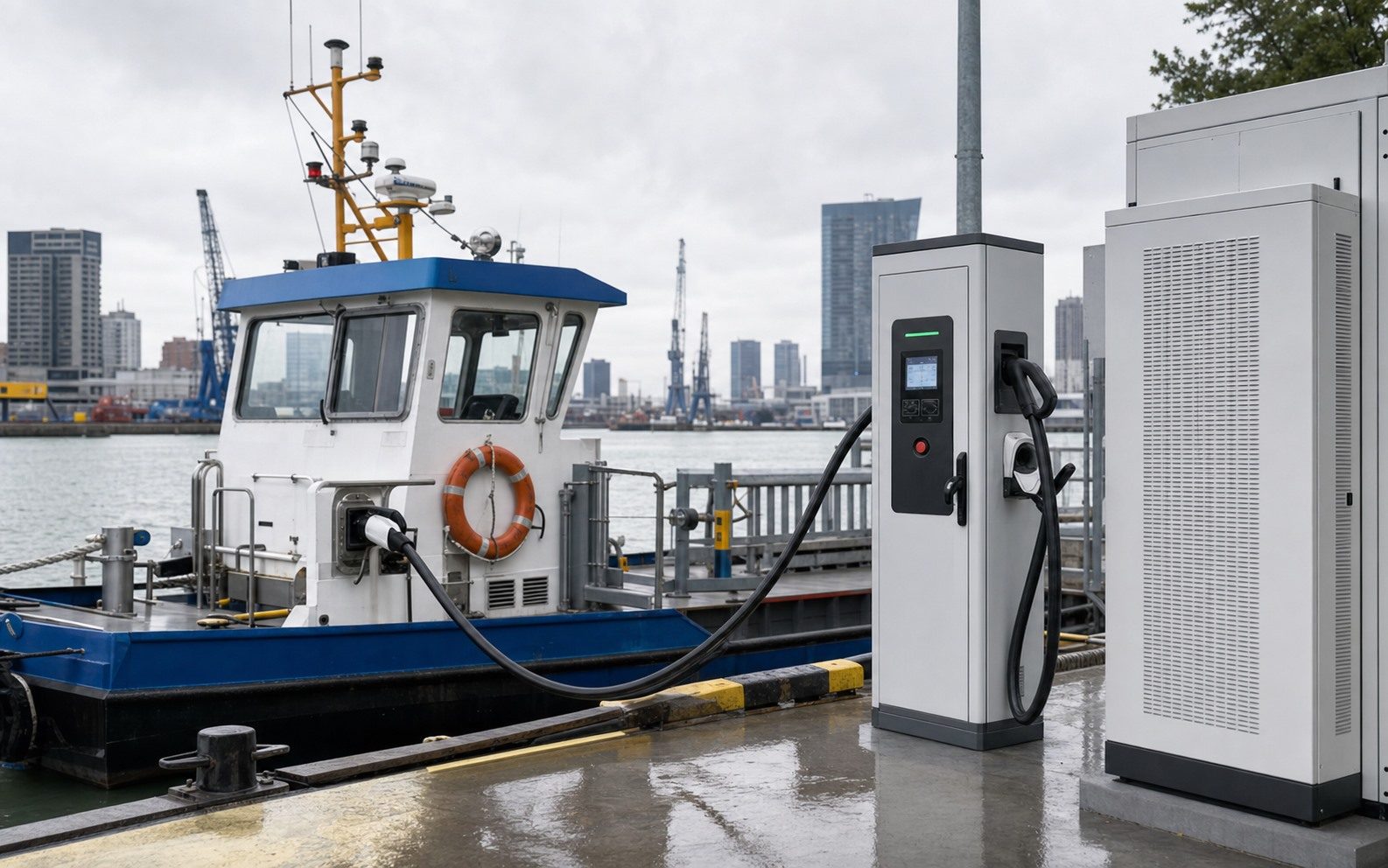
Technical Questions to Resolve
- Confirm whether the target vehicle or vessel interface supports the required bidirectional power-transfer mode and connector.
- Separate charger functions from site EMS, meter, protection, utility and local approval responsibilities.
- Define pilot test cases, power limits, fallback behavior, cybersecurity, data ownership and acceptance records before hardware approval.
Scope and Responsibility Matrix
| Workstream | Questions to close | Typical owner |
|---|---|---|
| EVSE hardware | Power direction, connector, rated input/output, protection, meter and cooling configuration. | Charger supplier and buyer engineering team |
| Vehicle or vessel interface | Supported protocol, battery limits, authorization and bidirectional operating envelope. | Vehicle/vessel OEM and system integrator |
| EMS and backend | Dispatch logic, OCPP scope, site signals, logging, alarms and cybersecurity. | EMS/CSMS integrator and operator |
| Grid and site approval | Interconnection, protection coordination, export limits, permits and inspection. | Local EPC, utility and authority |
| Pilot acceptance | Test cases, pass/fail criteria, evidence package, responsibilities and scale-up gate. | Buyer, operator and contracted suppliers |
Buyer Decision Boundary
This planning reference identifies information that should be resolved before a pilot or commercial deployment. Feasibility and compliance depend on the selected vehicle, charger, site system and local grid rules; no performance or deployment result is asserted here.
RFQ checklist for a similar project
Send destination country, charger power or storage capacity, site type, expected quantity, connector standard, communication protocol, certification needs, branding requirements and target delivery schedule.
Marine and V2G procurement notes
For marine or port pilots, confirm bidirectional charging objective, shore-side grid condition, vehicle or vessel interface, ISO 15118/V2G readiness, safety boundary and whether the first order is a pilot or commercial batch.
Technical starting points: review the ISO overview for ISO 15118-20 bidirectional power transfer and the Open Charge Alliance overview of OCPP between charging stations and management systems. The applicable edition, implementation profile and local grid rules still require project-specific confirmation.
Buyer route for similar projects: start with the commercial EV charger page, verify factory capability on the factory page, confirm documents on the certificates page, and use the OEM factory page if branding, firmware or packaging is part of the order.
Project details SUNFULL needs before recommending AC/DC chargers
For a similar project, a useful RFQ should include the country, site type, available grid capacity, expected vehicles per day, preferred AC/DC charger mix, connector standard, OCPP or payment scope, certification requirements and first-batch quantity.
- Commercial EV charger manufacturer page for parking, hotel, CPO and fleet project scope.
- AC charger page for 7kW, 11kW and 22kW long-dwell charging.
- DC fast charger page for 60kW, 120kW, 150kW and highway/fleet charging.
- OCPP charger support page when backend, RFID, payment or CSMS integration is required.