Short answer for Netherlands marine V2G buyers
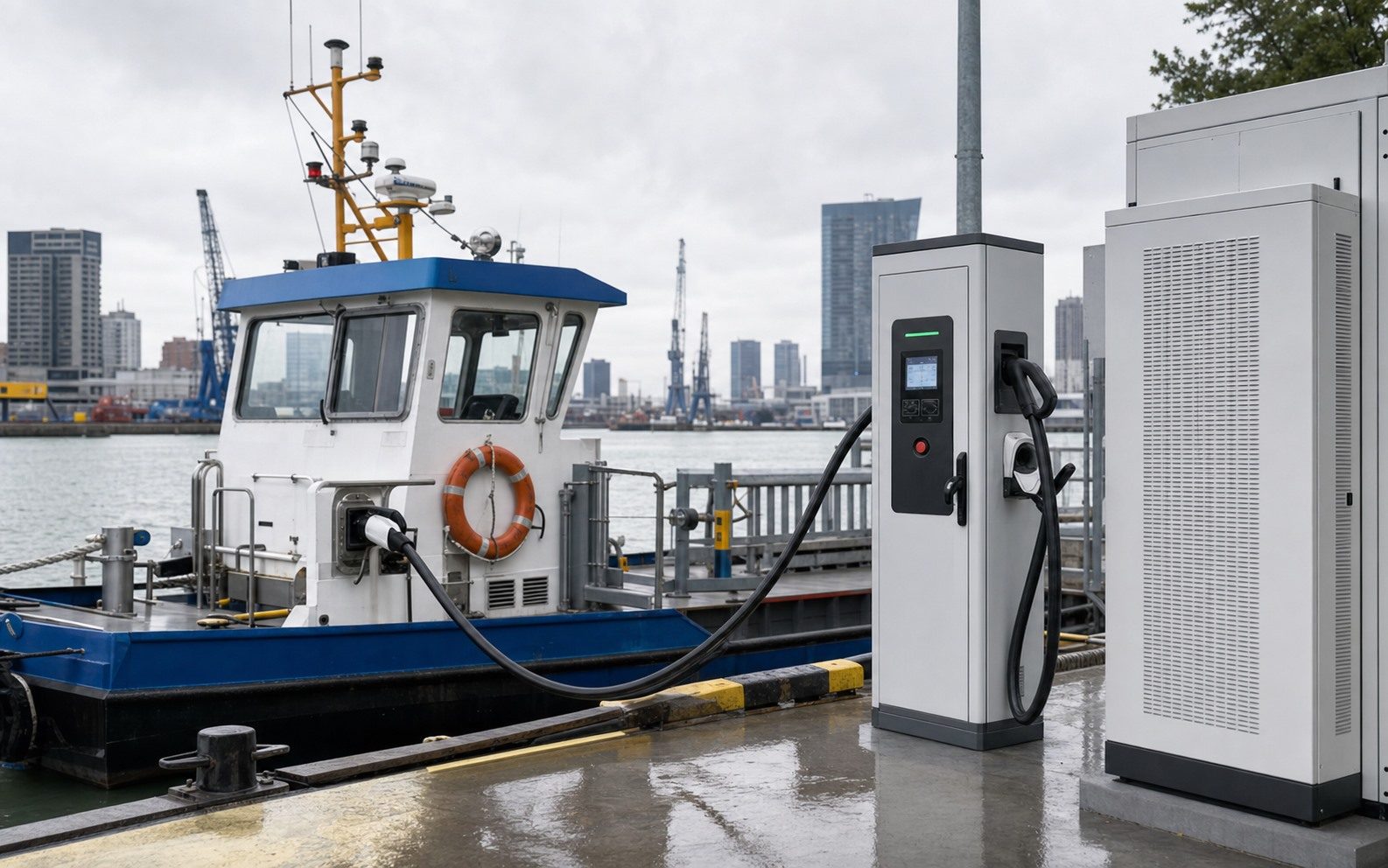
A port or vessel project should not start with a generic claim that a charger is V2G-ready. Confirm the vessel battery and interface, continuous charge and discharge power, berthing schedule, ISO 15118 functions, CSMS or EMS, metering, grid-export permission, marine environment and acceptance test.
Separate public market context from supplier evidence
Netherlands port electrification and bidirectional-energy discussions can indicate market direction, but they do not prove that a specific supplier delivered a project. Request an official project source and a document that identifies the supplier role before relying on a named reference.
If no such evidence is available, treat the example as a planning scenario. The quotation should stand on the proposed model, interfaces, test scope and contractual responsibilities.
Marine V2G technical checklist
What the supplier should document
- Exact model and hardware revision proposed for bidirectional operation.
- Charge and discharge ratings, thermal limits, protection and test conditions.
- Supported vehicle or vessel interface and ISO 15118 functions.
- CSMS, EMS, meter and site-controller integration boundary.
- Factory acceptance, site acceptance and interoperability test plan.
- Commissioning, spare parts, firmware and after-sales responsibilities.
Use a staged procurement path
Start with an interface study, then freeze the technical requirement, select a test configuration and define acceptance criteria before ordering a larger batch. Marine V2G should not be procured from a catalog power rating alone.
Send a Netherlands port or marine requirement
Share vessel type, connector, battery voltage, bidirectional power, berthing schedule, site voltage, grid-export objective, CSMS or EMS and project stage.
Buyer FAQ
Is ISO 15118-20 enough to prove marine V2G compatibility?
No. The vessel, charger, certificate chain, site controller, CSMS or EMS and grid interface require end-to-end testing.
Can a normal DC fast charger be used?
Not unless the exact model has a documented bidirectional power stage and the required vehicle, protection and control interfaces.
What should be agreed before price comparison?
Agree the interface list, power duty, environmental conditions, approval boundary and acceptance tests first.
Next steps
Prepare a vessel and site interface sheet, then request a model-specific feasibility review through the official RFQ form.