V2G buyer answer
V2G requires more than a charger label. A procurement team should confirm bidirectional power hardware, ISO 15118 support, OCPP/CSMS integration, metering boundary, grid operator approval, vehicle compatibility, warranty impact and whether the site actually needs V2G instead of simpler AC charging, DC fast charging or BESS buffering.
What is V2G?
Vehicle-to-Grid (V2G) is a technology that enables bidirectional power flow between an electric vehicle's battery and the electrical grid. While conventional EV chargers only draw power from the grid to charge the vehicle battery (unidirectional), V2G-capable chargers can also discharge the vehicle battery back into the grid — effectively turning parked EVs into distributed energy storage assets.
The principle is elegantly simple: most passenger EVs are parked 95% of the time. During those parked hours, their battery packs represent enormous distributed storage capacity that grid operators could theoretically access for grid balancing, peak shaving, and renewable energy integration — if the right hardware and software protocols are in place.
Why V2G matters for grid stability
Modern power grids face a fundamental challenge: electricity supply and demand must balance in real time. As renewable energy penetration increases — solar and wind are inherently intermittent — this balancing challenge intensifies. A grid with 40% solar penetration might see midday demand-supply mismatches measured in gigawatts.
Traditional response mechanisms include:
- Peaker plants — Expensive gas turbines brought online during peak demand; high operating cost and carbon emissions
- Battery storage — Utility-scale BESS installations; effective but capital-intensive ($400-600/kWh installed)
- Demand response — Paying industrial users to reduce consumption; limited scope
V2G offers a fourth mechanism: using the aggregate capacity of parked EVs as a virtual power plant. A fleet of 1,000 EVs with 60kWh batteries each represents 60MWh of distributed storage — without requiring dedicated infrastructure investment.
How V2G works technically
The V2G communication stack is built on ISO 15118, the international standard for plug-in vehicle to grid communication:
- ISO 15118-2 — Defines the handshake and session management for bidirectional power transfer
- ISO 15118-20 — Adds advanced features including Plug & Charge (automatic authentication and billing), bidirectional metering, and scheduled charging/discharging profiles
- OCPP 2.0.1 — The backend protocol enabling charge point operators to manage V2X sessions, set discharge prices, and coordinate fleet-wide energy flows
On the hardware side, V2G requires bidirectional DC-DC converters capable of controlled discharge, plus grid-forming inverter functionality to match grid frequency and voltage specifications. Not all bidirectional chargers are equal — the quality of grid-forming capability determines how stably the charger can island from the main grid and form a stable local AC supply.
V2G, V2H, and V2L: the terminology
The broader "V2X" (Vehicle-to-Everything) family includes:
- V2G (Vehicle-to-Grid) — Discharge back to the utility grid; requires grid operator agreements and revenue metering
- V2H (Vehicle-to-Home) — Discharge to the home during a power outage or peak rate period; simpler regulatory framework
- V2L (Vehicle-to-Load) — powering external devices from the vehicle; available via AC socket or DC output
Public pilot context and supplier evidence
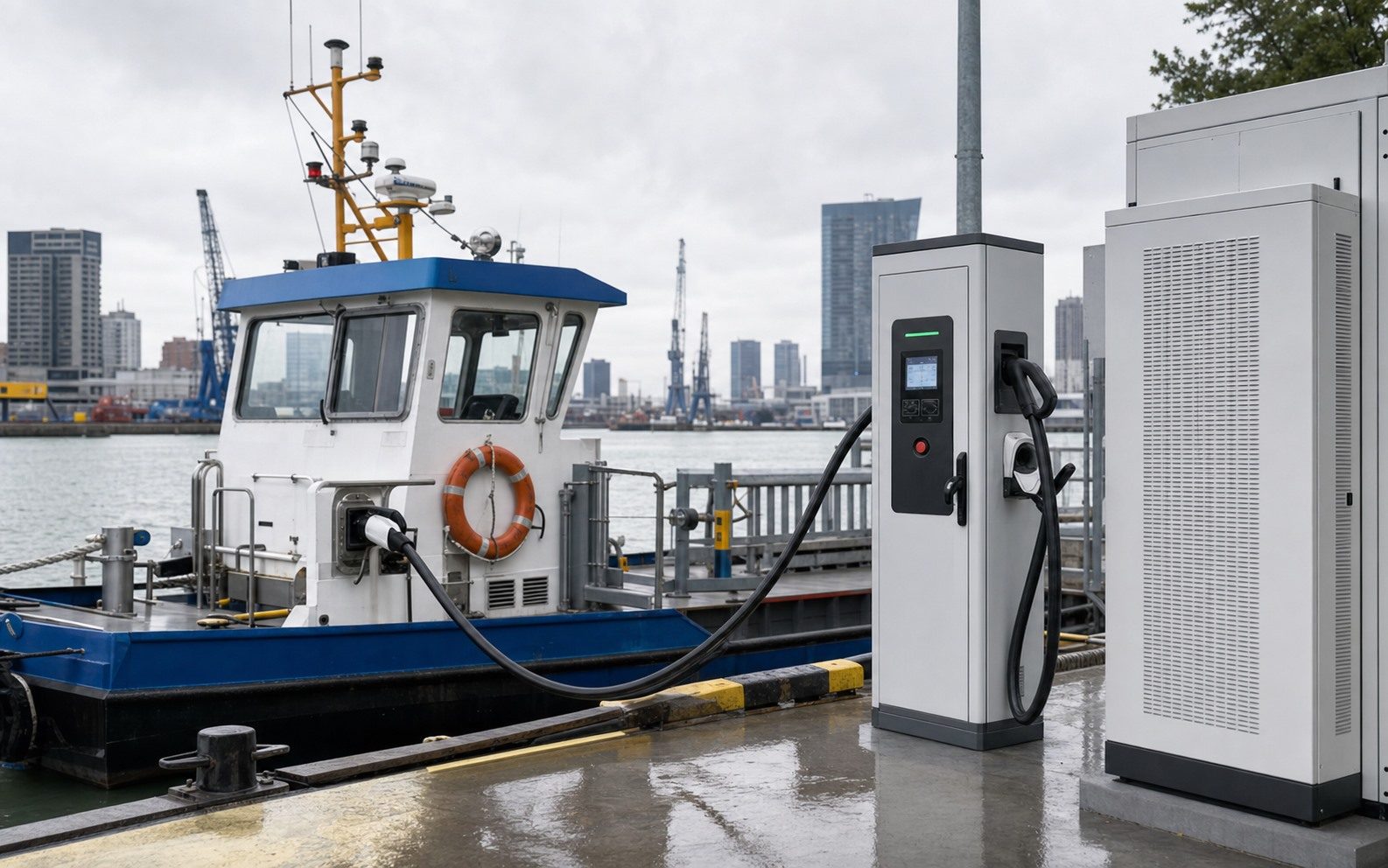
Wuhan Yangluo International Port is included in China's national vehicle-grid interaction pilot program. Official public sources identify the project context and project organizations, but a supplier should claim participation only when it can document its contractual or accepted equipment role.
For procurement, separate public market evidence from vendor evidence. Verify the exact charger model, vehicle interface, bidirectional power stage, grid function, commissioning scope and measured acceptance results before treating a pilot as transferable.
- Battery impact is vehicle-specific — confirm vehicle warranty, BMS limits and permitted cycling strategy.
- Revenue is market-specific — aggregator access, tariffs, metering and dispatch rules determine the business case.
- Grid connection is site-specific — utility approval, protection, export limits and cyber-security cannot be inferred from another pilot.
V2G RFQ checklist for commercial buyers
Before requesting price, define the business case and the technical boundary. This prevents suppliers from quoting incompatible pilot hardware.
Ask an engineer whether V2G fits your project
Send charger type, power, connector, vehicle model, software scope and target market. SUNFULL will suggest whether V2G, V2H, DC fast charging or AC charging is the practical option.
Buyer FAQ
Is V2G the same as smart charging?
No. Smart charging controls when and how fast a vehicle charges. V2G also allows controlled discharge from the vehicle battery back to a site or grid.
Should every commercial site buy V2G chargers?
No. Many parking, hotel and fleet projects are better served by AC wallbox charging, DC fast charging or BESS buffering unless reverse power has a clear commercial or grid-service purpose.
What should I send to SUNFULL for a V2G recommendation?
Send country, vehicle type, connector, required power, grid or backup goal, OCPP/CSMS requirement, quantity and expected project timeline.
How to evaluate a V2G supplier portfolio
Ask the supplier to map each proposed configuration to the exact vehicle, connector, ISO 15118 functions, charge and discharge ratings, CSMS or EMS, grid-interface requirements and test evidence. Do not assume one product supports every V2G, V2H, fleet or marine application.
- Residential V2H — confirm vehicle support, building transfer architecture and utility rules.
- Fleet V2G — confirm controlled vehicles, duty cycle, aggregator or EMS and acceptance tests.
- Port and industrial projects — require a dedicated engineering study for interface, power, protection and environmental conditions.
- Protocol claims — verify the exact OCPP and ISO 15118 profile with end-to-end interoperability testing.